
Guides › Crossbow for disabled hunters
Crossbows for Disabled Hunters: How to Choose One for Your Needs
Disclosure: this guide contains Amazon affiliate links. As an Amazon Associate we earn from qualifying purchases, at no extra cost to you.
A crossbow is often the easiest way back into bowhunting when a disability makes a vertical bow hard or impossible. But "a crossbow" isn't one thing - the right one for a hunter in a wheelchair isn't the right one for someone with arthritis in both hands. A good place to start is crossbows with a built-in crank (on Amazon), because cocking is the hardest part for most people. Then match the rest to your needs below.
Short answer: pick by what's hard for you. If it's strength or grip, get a crossbow with a built-in crank that can also de-cock it, so you never have to shoot to unload. If it's holding the weight, plan a mount or rest from day one and choose a light, compact crossbow that fits it. If it's your hands, make sure you can reach and work the safety and the trigger. If it's your eyes, a lit scope helps, and some states allow a laser sight for blind hunters with a sighted helper. Permits and adaptive triggers are covered in our guide to adaptive crossbow equipment and disability permits.
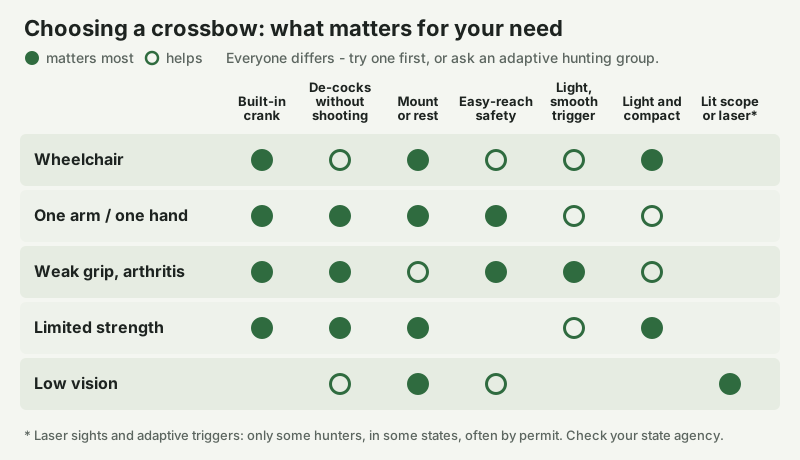
Start with cocking - and uncocking
For most hunters with a disability, the hardest moment isn't the shot. It's cocking the crossbow, and then getting it safely uncocked at the end of the day.
- A built-in crank turns a heavy pull into easy turns of a handle. TenPoint, for example, says its ACUdraw De-Cock crank cocks with about 5 pounds of force.
- De-cocking without shooting. Most crossbows can only be unloaded by shooting a bolt into a target. Some built-in cranks also let the string down for you. TenPoint's ACUslide has a brake, so the handle stops in place if you let go while cocking or de-cocking. Only de-cock a crossbow if its manual says it's built for it.
- If someone cocks it for you, have them do it right before you settle in, and stay within the maker's limit for how long it can stay cocked (how long a crossbow can stay cocked).
Crossbows with these built-in systems sit at the top of the price range. If your budget is tighter, an add-on crank made for your exact model does the cocking half of the job.
Hunting from a wheelchair
From a chair, you shouldn't have to hold a crossbow up at all. Plan the mount and the crossbow together:
- Mount or rest first. Options run from a simple rest on a shooting table to wheelchair-mounted systems. Before you buy a crossbow, check that the mount maker lists it or that it fits the mount's clamp.
- Light and compact. A shorter, narrower crossbow is easier to swing inside a blind and around your chair, and a lighter one is easier to lift onto a mount. Our ground blind guide covers window height and limb clearance.
- Front-heavy feel. A crossbow carries its weight up front. In a mount that's fine; held by hand, it tires you fast.
- Reach. Sit in your hunting position and check that you can reach the safety, the trigger and the crank handle without leaning.
For hunters with little or no arm movement, there are fully adaptive systems. One example, Be Adaptive Equipment's HQ100 mount, holds a crossbow, rifle or shotgun on the wheelchair, aims with a chin or forearm joystick and fires with light suction on a tube. The assistive-technology program that lists it says it needs training for safe use, so set it up with a therapist or an adaptive hunting group.
One arm or one hand
Shooting a crossbow with one arm works because a mount or rest can hold the crossbow instead of your other hand. Things to check:
- Cocking: a crank turns cocking into one-handed turning, but the crossbow still has to be held steady - in a mount, a rest made for it, or by a helper. Use the cocking position your manual shows.
- The safety: you need to work it with the hand you have. Some crossbows have it in the middle, others on one side; our left-handed crossbow guide shows where to look.
- Loading: placing a bolt takes one hand, but practice it in your real setup before the season.
Weak grip, hand problems or arthritis
With stiff or sore hands, the small controls matter most:
- Crank cocking, as above - the biggest single help.
- The trigger: look up its pull weight in the specs and, better, try it in a shop. A light, crisp trigger is easier to work with stiff fingers.
- The safety: a lever you can push with your thumb or the side of your hand beats a tiny slide.
- Cold hands: stiffness gets worse in the cold. Check you can still feel and work the trigger and safety with the gloves you'll wear.
- Adaptive triggers, such as trigger extensions or breath-tube releases, exist for hunters who can't pull a trigger at all. Many states require a permit for them - see our adaptive equipment guide.
If your strength is limited overall, the same fitting points as for smaller shooters apply: weight, length of pull and cocking effort (fitting a crossbow to a smaller shooter).
Low vision
- A lit scope: a reticle that glows helps at dawn and dusk and against dark backgrounds.
- Laser sights: some states allow them for hunters with a visual disability. Michigan, for example, lets legally blind hunters use a laser sight on a crossbow when a sighted adult goes with them; the DNR's page lists the rest of the conditions.
- A helper at your shoulder: where it's allowed, a sighted partner can help confirm the target and the shot.
Rules for visually impaired hunters differ a lot by state, so start with your own state wildlife agency.
Try before you buy: groups that help
The surest way to know what works for you is to try it. These groups host hunts and share equipment ideas:
- NWTF Wheelin' Sportsmen - the National Wild Turkey Federation's program, running since 2000, with chapter events for people with injuries or mobility impairments.
- Buckmasters American Deer Foundation (BADF) - its chapters host hunts for hunters with disabilities at no charge, and it offers equipment grants to qualified hunters.
- Physically Challenged Bowhunters of America (PCBA) - a nonprofit founded in 1993 to help people with disabilities take part in bowhunting and archery.
A quick checklist before you buy
- Is a crossbow legal for your hunt, and do you need a permit for any adaptive gear?
- Can you cock it with a crank - and does it de-cock without shooting?
- Will it fit your mount, rest or blind?
- Can you reach and work the safety and trigger in your real hunting position, with gloves on?
- Have you tried it, or something like it, at a shop or an adaptive hunt?
Frequently asked questions
What is the best crossbow for a disabled hunter?
There isn't one best model - it depends on what's hard for you. For limited strength or grip, look for a built-in crank that also de-cocks; for a wheelchair, a light, compact crossbow that fits your mount; for hand problems, a safety and trigger you can work easily.
Can you shoot a crossbow from a wheelchair?
Yes. Many hunters use a rest or a wheelchair mount so they never hold the weight, and fully adaptive mounts can aim with a joystick and fire with a breath tube. Check your state's rules on adaptive triggers.
Can you use a crossbow with one arm?
Yes, with a mount or rest holding the crossbow. A crank makes cocking a one-hand job as long as the crossbow is held steady, and you need a safety you can reach with your working hand.
What crossbow is easiest to cock with arthritis?
One with a built-in crank. TenPoint says its ACUdraw De-Cock crank needs about 5 pounds of force, and cranks that also de-cock save you from shooting to unload.
Can a blind person hunt with a crossbow?
In some states, with help. Michigan, for example, lets legally blind hunters use a laser sight on a crossbow when a sighted adult goes with them. Check your own state's rules.
Sources and further reading
- TenPoint: ACUslide and ACUdraw De-Cock - built-in crank cocking and de-cocking, about 5 lb of force
- Montana Assistive Technology Program: Be Adaptive HQ100 mount - crossbow control with a chin or forearm joystick and a breath-tube trigger; training needed
- Michigan DNR: laser sighting devices for hunters with disabilities - legally blind hunters, crossbows, a sighted adult along
- NWTF: Wheelin' Sportsmen - events for people with injuries or mobility impairments
- NRA Family: a helping hand for the disabled hunter (BADF) - free chapter hunts and equipment grants
- SIU News: archery hunts at Touch of Nature - Physically Challenged Bowhunters of America, founded 1993
- List of U.S. state fish and wildlife agencies - find your own state's rules
How this guide was written: Based on manufacturer pages (TenPoint), an assistive-technology program listing for an adaptive mount, a state wildlife agency rule (Michigan DNR) and the published programs of adaptive hunting groups. We have not tested these products; check the details for any crossbow in its own manual and your state's current rules.